Revealing the Research: 10 Years of Being Data-Driven and Evidence-Based

Adam Becker

by Adam Becker, PhD, MPH, Executive Director

Happy New Year!  2012 is an especially happy new year for CLOCC as it marks our 10th year as a Consortium collaborating on childhood obesity prevention in Chicago and beyond!  I hope that as partners you will feel as proud of our shared accomplishments as we do as staff members.  Throughout this 10th year we will be reviewing our past successes, highlighting our current collaborative work, and visioning for our future. We have several special events and projects planned that will unfold in 2012 to commemorate this important 10-year milestone – watch for details in the coming weeks and months!  We have organized these activities around quarterly themes that have been important for CLOCC as we’ve grown since 2002 and that will carry us into the next 10 years. In our first quarter, we reflect on data and evidence.  These were instrumental in the consortium’s origins as we built our efforts on what we knew and what we still needed to learn about childhood obesity in Chicago.  We will also focus this quarter on research and how it undergirds our data-driven and evidence-based approach.

So first, I would like to remind you of where we began.

Thanks to the vision of our founder, Dr. Katherine Kaufer Christoffel, and initial funding from the Otho S.A. Sprague Memorial Institute, CLOCC came into being in late 2002. Our first meeting drew about 40 people from across the city – pediatricians, staff from community-based organizations, researchers, representatives from city agencies, and others. We were a diverse group even then! 

It may be hard to believe now, but back in 2002 we faced the hurdle of convincing people that the childhood obesity epidemic was actually real, so data and evidence have always been important to CLOCC. The gathering and dissemination of data served us well at the very beginning when, under the leadership of our founding Executive Director, Matt Longjohn, we started to build our consortium. Most people had no idea where the city stood in terms of childhood obesity rates, but our interest in finding out helped Kathy and Matt to make the case to potential partners that they should get involved in this growing collaborative effort. In fact, back in 2002 the prevalence data were scarce, but even the little we had told an alarming story.  The 1999 National Health and Nutrition Examination Survey (NHANES) data indicated that 13% of children ages 6 – 11 and 14% of adolescents ages 12 – 17 were obese.   Our goals back then were to share the data we had to motivate individuals and organizations to join the consortium and to work toward collecting more.

A major early success was the release of the first citywide prevalence data for Chicago children entering school for the first time (children aged 3 – 7) at the end of 2003. They were collected through a partnership with the Chicago Public Schools and the Archdiocese of Chicago under the leadership of research scientist Dr. Maryann Mason, who now serves as our Community Research and Evaluation Director. The data showed that nearly one quarter (24%) of Chicago children were entering school already obese — two and a half times the national average at that time. This data release literally put CLOCC on the map, with coverage on the front page of both the Chicago Tribune and the Chicago Sun-Times.

Since those early days we have worked hard as a consortium to keep our collective eyes on obesity rate data. We held the Child Health Examination Surveillance System Summit in 2008 to develop statewide consensus and gather recommendations to create a surveillance system using data from the child health examination forms. While attention to the issue has ebbed and flowed over the years, the state is showing re-emerging interest. The Illinois Alliance to Prevent Obesity, a statewide coalition of organizations focused on obesity prevention for all Illinoisans, identified surveillance as one of three top priorities for their first year of action. The city is making great strides as well, with a five-year inter-agency agreement between the Chicago Department of Public Health and Chicago Public Schools to look at prevalence rates now and into the future. These advances have grown out of our consortium’s initial work and are laying the groundwork for a system that would provide up-to-date and annual  obesity prevalence data.  These data will help us as a state and city to allocate resources strategically, where prevention and intervention are needed most – decisions that are best made when data-based.

CLOCC staff and partners conducted a second round of surveillance in 2009. The great news was that we found a reduction of 2% in the overall prevalence of obesity among children aged 3-7 years old. The not-so-great news was that even with this new prevalence rate of 22%, we were still twice the national rate of 10.4%. Knowing that our staff would not have the resources to continue to do this surveillance at the frequency with which it is needed, we have been advocating for the state and the city to create a sustainable system for monitoring child health statistics, with a focus on obesity.

But data and surveillance have not been our only activities related to generating knowledge about the issue. In 2003, we kicked off our Seed Grant Program.  CLOCC Seed Grants provide small amounts of funding to support the development of local research and evaluation efforts to contribute to our knowledge base and to increase the capacity of local investigators to get increased funding to continue or expand their work.  In 2007, we revised the Seed Grant Program to fund fewer projects but at greater amounts.  In 2010, we released a report on the impressive work done through our Seed Grant award recipients.  A number of our grantees have been able to publish in national journals, influence local policy, expand local programs, and obtain large federal grants to continue their work. 

Here in the CLOCC office, some of our staff members have also conducted research; some on behalf of our partners.  For example, I led a study to help the City of Chicago Inter-Departmental Task Force on Childhood Obesity understand that impact that the new standards for food and physical activity in childcare centers have on center practices in low-income communities across Chicago. The findings of this study have already begun to help shape education and training mechanisms for Chicago’s childcare providers and have contributed to a statewide interest in the role that childcare providers can play in the health of the very young. Other research we conducted in our first ten years has included exploration of expanding obesity prevention services tied to distribution of free produce, evaluation of the Open Streets initiative which closed street routes to auto traffic to create safe places for physical activity in five Chicago communities and evaluation of a Chicago Park District program designed to provide opportunities for increased physical activity in after school programming.  We’ve also conducted multiple waves of a community health survey in Humboldt Park and Englewood and done a baseline survey in Pilsen

Looking to the future of our data, research and evaluation activities, we will continue to provide evaluation services and capacity building to CLOCC partners.  We will continue to support CDPH and CPS as they develop a system for reporting on childhood health indicators, including BMI.  We will continue to encourage the State of Illinois to develop a similar system.  And we will continue to monitor and disseminate the most up-to-date research from across the country to help us locally to remain on the cutting edge of best-practice obesity prevention strategies.  You can also look forward to further changes to our Seed Grant program – with a more specific focus on policy, systems, and environmental change – an important emerging element of our work in Chicago communities.

And this brings me to next quarter’s theme!  Look for a new post from me in April when I will talk about the lifeblood of CLOCC, our community partnerships – past, present, and plans for the future. Talk to you then!

Our 2003 data release was the lead story in the December 3, 2003 issue of the Chicago Sun-Times.

Posted in 10th anniversary, data, history | Leave a comment

Crossing Oceans and Moving Mountains: Reflections from CLOCC’s Founder

Katherine Kaufer Christoffel

Katherine Kaufer Christoffel

by Katherine Kaufer Christoffel, MD, MPH, Founder and Medical and Research Director 

At the CLOCC holiday dinner this year, I had the chance to present a short talk to reflect on and celebrate nine years of CLOCC. I shared thoughts on how CLOCC went from the twinkle of an idea of mine to the impressive force for change that now involves the many individuals and organizations in the consortium.  Here are some highlights, which may be of interest to the broad range of people who are interested in CLOCC and its work. 

The theme I used was ‘crossing oceans and moving mountains’, reflecting both my meandering path and its lessons, and also the path that CLOCC has taken: to create CLOCC’s broad coalition, we have had to cross boundaries as forbidding as oceans.

My journey started a few years after WWII, when I was born in NYC to two immigrants from Eastern Europe, who crossed oceans in their childhoods to reach a new life and who were actively committed to education and social justice. I was raised in Stuyvesant Town in Manhattan, a kind of urban suburb with a lot of green space and no through traffic.  I had a fine education in the NY public schools, and then in college and medical school.  Much of what I know about ground-up policy change was learned in anti-war activism in Boston during college and the years that followed. That work required base-building and coordination of effort around the campus and around the country. It taught me about compromise and how it is unwise to be too sure about things, as there is always much to learn and history has a way of showing those who are certain to be fools. 

Those early years taught me lessons that I later applied to CLOCC. I learned that oceans can be crossed, life’s obstacles can be overcome, mountains of injustice can be identified and moved. That it takes many to achieve important goal. The successes of the civil rights and anti-war movements taught me boldness and optimism. 

It was when I entered medical school that I dedicated myself specifically to health and health promotion.  My choice of pediatrics was made because I was sure that caring for children would always remain compelling and optimistic.  It was and it has been a pleasure and privilege working with children and families. I am humbled and always will be by the welcome granted to me to enter the private space that children share with their adults. The physical exams are intimate, of course, but in many ways that is the least of it. To be of help, I had to learn how families work, hour by hour, week by week, year by year. People trusted me to pry and spend time with them to learn about them. To cross the ocean that divided us. My attention gradually turned to problems related to primary calorie imbalance, both malnutrition and obesity, and this became my clinical focus for decades. 

After residency, I began my public health studies. This took me beyond a purely clinical focus, and on to research. The research ultimately led to advocacy, particularly related to injury prevention, and most particularly to firearm injury prevention.  I learned many lessons from that work and its challenges and successes, and these informed the design of CLOCC.  Some memorable ones are these:

  • Partner with others who have complementary work preferences and skills.
  • Understand your limited perspective.
  • Remember that many things can’t be controlled.  
  • Work in teams, which achieve the most and provide perspective. 

In terms of oceans and mountains, this phase taught me not to stop at the oceans (between medicine and other realms), to take the measure of the mountains being moved and plan appropriately (when needed, audaciously), and to take a long view.  

When evidence of the obesity epidemic showed up in my examining room, I saw that protecting kids from this scourge requires approaches well beyond what can be offered in the clinic. This was clearly a very big mountain indeed, spanning many areas of life and unjustly affecting the most those most in need. I took its measure and concluded that what was needed was a very comprehensive approach, with a focus on primary prevention and so an emphasis on young children. 

What I proposed to funders was a multi-sector coalition that would address issues at multiple social levels, from patients to families to communities to society and policy. Chicago was fortunate that the Otho S.A. Sprague Memorial Institute invested in this early, when it was still an idea, and then for several years. With the effort of many and the support of numerous funders, CLOCC today connects regularly with over 1,200 organizations and over 3,500 individuals.   Led by two extraordinary Executive Directors—Matt Longjohn and Adam Becker—and working in every social sector, CLOCC staff and partners have really built something remarkable!    Our experience together confirms that the lessons I learned in other arenas—about oceans and mountains, audacity and optimism—are applicable in this one. 

CLOCC has some big accomplishments that are worth savoring, including (in no particular order): 

  • This month saw CLOCC’s 36th Quarterly Meeting!  Each one draws around 150 or more participants and is remarkable in its diversity.
  • Chicago is home to the award-winning Inter-Departmental Task Force on Childhood Obesity (IDTF), midwifed by CLOCC, led by the Chicago Department of Public Health (CDPH), and now including 12 city agencies.
  • CLOCC’s healthy lifestyle message, once a dream, is the well-established 5-4-3-2-1 Go!.  It has been translated into several languages, is widely taught and used across Chicagoland, and is a living tool in 49 states and several nations around the world.
  • CLOCC, under the leadership of Maryann Mason, CLOCC’s Community Research and Evaluation Director, developed a novel way to use school health forms to measure obesity prevalence in school kids. We documented that 26% were obese at school entry in 2003 and later that this rate had fallen to 23% in 2008, showing the power of the coordinated obesity prevention approach that CLOCC built.
  • Healthy Places is the Chicago obesity prevention project funded by the federal Communities Putting Prevention to Work Program. CLOCC manages it, as the bona fide agent for the City, working closely with CDPH and other city agencies and with community groups. This project is meeting ambitious goals in areas that include increased access to healthy foods, improved safe use of parks and streets, healthy school environments, and increased breastfeeding support in the city’s 19 maternity hospitals.
  • CLOCC has been tapped to share its experience with other cities, with researchers at NIH, with faith and community leaders gathered by the White House, and many others. People around the country know CLOCC and notice what we do. 

In these and other ways that continue to increase and expand, CLOCC consistently crosses oceans to share practical approaches to moving the obesity mountain. Of course there is much still to be done, but we can already be very proud of what CLOCC is and has already done!

I hope the wonderful CLOCC team will always be audacious and optimistic, like the original twinkle of the CLOCC idea.  And I hope that everyone in CLOCC will remember, in this important, collaborative work, the three things that form the heart of all work in public health, which I learned from a colleague who learned it from a colleague … and now some of you are learning them from me.  The 3 Ps are easy to remember:  Patience, Persistence … and a sense of humor.  

Posted in history, reflections | Leave a comment

Taking Walkability to the Streets at the Safe Routes to School National Conference

Grant Vitale

by Grant Vitale, Community Programs Manager 

CLOCC Community Networkers Ed Boone, Elvia Rodriguez-Ochoa, and Miguel Morales and I recently attended the Safe Routes to School (SRTS) National Conference.  It was held on August 16-18, 2011 in Minneapolis, Minnesota.

The Safe Routes to School National Conference now in its third year was hosted by the National Center for Safe Routes to School and the Safe Routes to School National Partnership. 

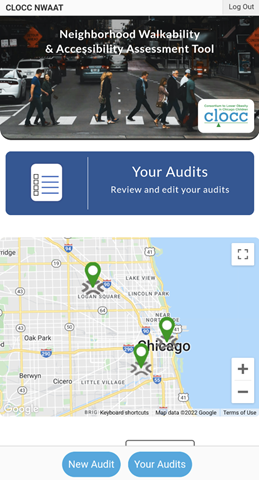
Ed and Miguel presented a Mobile Workshop on Coalition Building and the Neighborhood Walkability Assessment Tool under the conference heading, Coalition Building and SRTS Programming.  Ed’s presentation focused on the successes of neighborhood coalition building in West Humboldt Park and Miguel’s presentation focused on the Neighborhood Walkability Assessment Tool and how to use it in community neighborhoods.  People from a variety of organizations and disciplines attended the workshop.  They turned out to be a group that was quite engaged and interested in the information presented.  They commented on how interesting the CLOCC tool was and how it makes one think about intersections and blocks in a completely different way.  It was great to take them out on the streets and show them how to assess the walking environment.

The SRTS National Conference offered walking tours and bike tours of Minneapolis as well as mobile workshops.  The mobile workshops addressed a number of topics such as design solutions to increase cycling and safety and assessing walkability for users of ages and abilities.  There was also breakout sessions on a wide variety of topics including injury prevention and social equality.  Antonio Rosell from Community Design Group in Minneapolis conducted a presentation on community participatory engagement, which gave great examples on how to ensure community member participation and input for different types of projects and plans.  Some of the concepts and ideas he presented will be very useful for the Networkers to use in neighborhoods when they are working to engage a wide variety of community members on a project.  Ed Ewing from Bicycle Club Cascade presented on the Major Taylor Project which is very successful in engaging youth in cycling in the Seattle area.  I especially enjoyed his presentation because it demonstrated the tremendous benefits of engaging youth in cycling.  The youth learned how to ride bikes and they acquired bicycle maintenance skills.  They were also able to progress from just learning how to ride to participating in endurance rides, which was amazing to see.  This session definitely relates to our work in West Town.

For more information on walkability, visit the Walkability Assessment page on the CLOCC website.  For more information on Safe Routes to School, visit the Safe Routes to School National Partnership website.

SRTS conference

Miguel leads conference participants in a neighborhood walkability assessment

SRTS workshop

Miguel (left) and Ed present at their workshop

Posted in networkers, walkability | Leave a comment

Promoting Health and Wellness at Jordan Elementary

Claudia Olayo

by Claudia Olayo, Rogers Park Networker 

As the CLOCC Community Networker for the Rogers Park neighborhood in Chicago, I have the chance to work with local schools to help promote health and wellness.  One that I have worked with is Jordan Elementary Community School.  Here are some examples of projects we have done together. 

In May 2010, Jordan School completed a Healthy School Environment Assessment facilitated by CLOCC staff. Some of the participants included school administration, teachers, parents, the school’s nurse, lunch room managers, and a few upper grade students.

After the results of the assessment were shared with the group, it was decided that the first step to address some of the issues identified was the creation of a School Wellness Council. Some of the aforementioned participants became the founding members and, voila! The Wellness Council was formed and has been meeting on a monthly basis. The team agreed the first issue to tackle was a lack of drinking water availability to the students during the school day; making drinking water more accessible to all Jordan students was the solution. The Wellness Council decided to use a small amount of grant money allocated from CLOCC to purchase water coolers/crocks in the shape of basketballs and soccer balls, which were approved by the student members of the Council, to be placed in the cafeteria and the gym. The coolers have been well received by parents and especially the students.

Another project the Wellness Council took on was the planning and realization of a Healthy Family Night, where a friendly game of Loteria, a Mexican version of Bingo, was to be played as an alternative to the usual unhealthy chocolate bar/candy sale fundraising.

The evening of March 24, 2011, 25 families turned out to take part in the Healthy Family Night. Parents and children alike participated in an interactive 25-minute bilingual presentation on CLOCC’s 5-4-3-2-1 Go! message. There was also a food demonstration in which a community volunteer engaged children in preparing a simple greens and quinoa salad with apples and walnuts. The parents and children enjoyed the salad and took home a copy of the recipe. That healthy hour showcasing the 5-4-3-2-1 Go! message was followed by an hour of Loteria where some won prizes, others learned a few words in Spanish, and all had fun!

For more information on 5-4-3-2-1 Go! and to see the free tools available for download, visit the CLOCC website.

Posted in networkers, schools | Leave a comment

Bringing a Healthy Message (and Fake Food) to Families at the Chicago Children’s Museum

Adam Paberzs

by Adam Paberzs, Health Education Intern

The Chicago Children’s Museum played host to a fun and family-oriented health and wellness fair on January 27, 2011 at Navy Pier. Kids and parents came from all over the city to learn about healthy habits, receive free screenings, and enjoy physical activities. I was there to represent CLOCC at the event.

The fair was an exciting and energetic event, and amidst the hustle and bustle, kids and families found their way to my table to learn about
5-4-3-2-1 Go!™  - CLOCC’s public education campaign to promote healthy lifestyles for children. The CLOCC table offered an interactive visual representation of the
5-4-3-2-1 Go! message using tools like food models that illustrated each of the healthy lifestyle recommendations. Kids and parents alike couldn’t resist touching the food models and comparing the different examples of servings of fruits, vegetables, and low-fat dairy. The kids especially loved (and even tried to taste) the orange, cheese, and strawberry models. The milk models won over even the museum staff, who expressed genuine shock at the amount of fat found in whole milk compared to skim.

My interaction with parents led to lots of interesting questions such as, “Does rice milk and regular milk have the same amount of nutrients?”, “How much cheese is too much?”, and “Do chores count as physical activity?” One father shared his concern about the nutritional quality of the lunches being served at his son’s day-care center.  We discussed some of the challenges he encountered working with the day-care staff, and ideas for communicating the importance of moving toward healthier food options. It served as a reminder of the important role schools and childcare facilities play in getting children the nutrients they need to be healthy.

The Chicago Children’s Museum continues to partner with communities and organizations like CLOCC throughout the city to promote healthy, active lifestyles for children and their families. Every Thursday, CCM hosts a Free Family Night that allows kids and families to experience a range of cultural, educational, and health and wellness activities.  During Free Family Night, the museum uses different exhibits to encourage fun physical movement, health and wellness, and a spirit of exploration.

To learn more about the Chicago Children’s Museum, visit the museum’s website.  For more information and a list of available 5-4-3-2-1 Go! resources, check out CLOCC’s
5-4-3-2-1 Go! home page.

Posted in 5-4-3-2-1 Go! | Leave a comment

Digging Into the Connection Between Gardens and Classrooms at a Healthy Teacher Network Workshop

Mara Lazdins

by Mara Lazdins, School Programs Intern

Learning how to plant vegetables in milk crates lined with burlap bags or how to integrate a science lesson into growing herbs, left a positive impression on teachers who attended Healthy Teacher Network’s third workshop in October, 2010.

For the first time, a school hosted the event, which gave teachers the opportunity to experience a school culture that encourages wellness, being active and eating healthy. At the workshop, which took place at Academy for Global Citizenship (AGC), teachers toured the school grounds and learned how the teachers there incorporate the garden into all subjects including recess. Participants were also able to taste components of Chicago Public School’s recently revamped school lunch menu, which received positive reviews.

Like at past workshops, teachers were able to obtain resources on healthy eating and physical activity at the Resource Fair. Sixteen organizations were present offering tools, information, and other resources that teachers could take back to the classroom or implement within their school. Overall feedback revealed that participants enjoyed the school tour, garden, and learning about how AGC builds wellness and sustainability into the curriculum.

So far, over 80 schools have been represented at the three Healthy Teacher Network Workshops. These 80 schools represent 28 Chicago zip codes—with the highest number of teachers coming from West Town, Lower West Side/Bridgeport/McKinley Park, Logan Square and Rogers Park schools. Teachers have expressed that attending the Workshops has been an “invaluable networking opportunity”, “a great way to learn about what other teachers and other schools are doing”, and a way to gain “new ideas for their classrooms.”

For more information on the Healthy Teacher Network, visit its page on the CLOCC website.

Teachers enjoyed touring the school garden and hearing how AGC staff have incorporated it into classroom learning.

The Resource Fair was a great place to pick up information and hear about the work of neighborhood organizations.

Posted in healthy teacher network, schools | Leave a comment

A Cool Evaluation Project at the Shedd Aquarium

Sarah Welch

by Sarah Welch MPH, Evaluation Manager

Opened May 22, 2009, the Polar Play Zone at the Shedd Aquarium in Chicago is the museum’s first permanent exhibit designed specifically with children (aged 2-7) in mind.  The Shedd Aquarium had designed the Polar Play Zone to be interactive and interesting to children as well as encourage physical activity while in the exhibit.  It includes four different areas for children to explore: (1) The Shallow Seas – where kids can play in tidal pools, touch sea stars and visit with sea otters; (2) The Deep Ocean – an underwater viewing area of the dolphin habitat; (3) The Icy South – the penguin habitat with a play area where kids can dress up like penguins and climb and slide up and down rocks, imitating the birds; and (4) The Icy North – where kids can learn about beluga whales and other cold water creatures while playing with a submarine.

Over the summer of 2010, CLOCC staff evaluated the physical activity levels of children visiting the Polar Play Zone as well as measured general activity levels of children visiting other parts of the museum.  Accelerometers, devices that measure the amount and intensity of movement, were worn by children between the ages of 3 and 7 during their visit to the museum.  This gave us information on how active children are while visiting the museum in general.  To see how active children were in the Polar Play Zone, we used an observation method called SOPLAY to count how many children were sitting or standing still, walking, or running while in the exhibit.  Using these two methods, we were able to gather information on activity levels of children visiting various parts of the museum as well as the Polar Play Zone in particular.  This information will help us know if museums provide a good source of physical activity for children in addition to their educational benefits. 

The data from this project are still being analyzed, so no results are ready at this time.  When they are finished, we will be sure to share them.  For more information on this project or CLOCC’s other evaluation activities, contact me at 312-573-7767 or swelch@childrensmemorial.org.

Summer intern Justine Bandstra and I dress the part in the Penguin Habitat. Justine assisted in the data collection.

Posted in evaluation | Leave a comment

Dr. Becker Goes to Washington

Adam Becker

by Adam Becker, PhD, MPH, Executive Director

With Congress back in session, I thought this would be a good time to reflect on my recent visit to Capitol Hill on September 16.  I was invited to serve on a panel by the National Association of Children’s Hospitals and Related Institutions (NACHRI) to brief Congress about the important role that children’s hospitals play in childhood obesity prevention.  NACHRI staff set up the panel to represent the broad range of roles that hospitals play – from community-based prevention to intensive clinic-based behavior change interventions, to surgical and other specialty care for those children who are in urgent need of treatment.  It was an honor to be among distinguished colleagues from hospitals in New York, Maryland, and Washington State.  It was a privilege to hear from a very brave young high-school senior and her equally courageous mother as they described the challenges and the heartbreak that their family faced dealing with childhood obesity. 

Staff members from the offices of more than 30 U.S. Representatives and Senators came to learn about childhood obesity and what hospitals and hospital-based programs were doing.  I couldn’t help but think about how important it had been to childhood obesity prevention that First Lady Michelle Obama took such a public stand on the issue.  I believe that this visible show of concern helped to bring so many people into that room.  I told them about the many partners who make up CLOCC – more than 1,000 organizations in Chicago and beyond who are at the “front lines” of obesity prevention; working to make sure that kids and families know what the elements of a healthy lifestyle are, understand the risks of not making healthy choices, and have access to environments that make healthy choices easier where they learn, play, and live.  I told them how the health care system was an essential component of the battle against obesity but that doctors alone cannot solve the problem. 

As I listened to the other panelists talk about how complex and challenging it is for them to find the resources and models they need to do the very complicated and hard work of treating overweight and obese children, I thought about how much harder it would be if those of us fighting to improve nutrition and physical activity for children weren’t there trying to keep kids healthy enough that they didn’t need treatment. 

I was truly humbled to be in one of the very buildings where decisions get made every day that affect children and families.  Decisions about how much money our schools will get to provide food to children.  Decisions about whether our transportation system will accommodate those who want to walk or ride their bikes for at least some portion of their daily commute.  Decisions about how much of the fertile soil across the U.S. will be used to feed people vs. animals vs. vehicles.  Decisions about how many children will have health insurance and what the quality of that insurance will be.  And yes, decisions about reimbursement to health care institutions for the basic and specialized services that are so essential to protecting children when they are overweight or obese.

Congress headed home for vacations or to work on their re-election campaigns before they decided on some of the critical issues facing children and families.  I am frustrated that Congress went home with so much work yet to do, but I continue to be hopeful because so many people showed up that day to hear from us and because so many champions for children and families are working every day in Chicago, in Maryland, in New York, in Washington State working hard to make sure kids grow up healthy and happy.

Posted in policy/advocacy | 1 Comment

Project SOAR Takes 5-4-3-2-1 Go! Promotion to New Heights

Jill Zubrod-Hernandez

by Jill Zubrod-Hernandez MPH, Health Educator

This past summer was a flurry of 5-4-3-2-1 Go!™ outreach thanks to our wonderful partnership with Project SOAR.  Project SOAR is a multifaceted family literacy program working with Head Start affiliated children, parents, and teens to develop literacy, leadership and employment skills.  It is housed at the University of Illinois at Chicago.  Learn more about Project SOAR here.

This has been a great example of a partner organization taking the 5-4-3-2-1 Go! message and running with it!  First, I trained the Team Leaders in the message and taught them how to lead games that were developed to reinforce the message recommendations.  (Learn more about CLOCC’s 5-4-3-2-1 Go! message here.)  Then the message spread like wildfire as the Team Leaders trained their Teen Nutrition Aides (200+ teens) in the message and related activities.  Once trained and ready to spread the message, the teens were deployed to 70+ sites across Chicago participating in the Summer Nutrition Program.  In total, over 1,250 children were reached with the 5-4-3-2-1 Go! message multiple times throughout the summer.  For more information on Project SOAR, contact Sam Austin, Youth Team Leader, at saustin3@uic.edu or 312-413-7403.

Children at one center applying what they have learned by sorting food and activity model cards into categories based on the 5-4-3-2-1 Go! message.

Teen Nutrition Aides commonly got the request to do “stations” with the preschool age kids. Here are children in two stations, one mastering their hula hoop skills, while the other practices tossing and catching a ball.

Following their physical activity stations, the Teen Aides made sure to have the children stretch out!

Posted in 5-4-3-2-1 Go! | Leave a comment

Creating a Healthy Environment at Cameron School

Mara Lazdins

by Mara Lazdins, School Programs Intern 

Recently, Cameron Elementary School, located in West Humboldt Park, successfully completed CLOCC’s  Healthy School Environment Assessment, a tool that helps schools identify current practices, policies, and programs for promoting healthy eating and physical activity. Through the process, 16 staff, with assistance from CLOCC and the Greater Humboldt Park Community of Wellness, identified several areas for improvement. In the action plan, they outlined specific goals including: incorporate nutrition education into the classroom and expand opportunities for physical activity throughout the school day.

Cameron, a school with a population of over 1,000 students, does not have the space or capacity to offer physical education on a weekly basis for every child. However, the school does provide 20 minutes of recess daily for grades K-8. To address their concern that students were not getting enough exercise, Cameron staff immediately recognized recess as an opportunity to maximize students’ time spent in moderate to vigorous physical activity, through structured, high energy activities.

On September 23, CLOCC staff (Health Educator Jill Zubrod, Community Networker Ed Boone, School Programs Coordinator Anna Barnes, and I) trained a group of four recess monitors and two physical education teachers on the 5-4-3-2-1-Go!™ message as well as games to promote the message. This was CLOCC’s first workshop specifically designed to support a school in implementing the message and activities into a school’s daily schedule, and it was received with high enthusiasm.

The group learned several games that could be incorporated into recess, and CLOCC provided the equipment and tools to enhance these activities such as hula hoops, buckets, jump ropes, and plastic food models. The participants also brainstormed solutions to some of their concerns with CLOCC staff and agreed to try some new methods and strategies over the next few weeks to address specific concerns. CLOCC will return to Cameron in a few weeks to visit a few recess sessions in action, gather feedback from the recess monitors and PE instructors, and provide ongoing technical assistance and support.

For more information on CLOCC’s school-focused work, contact Anna Barnes at 312-573-7766 or abarnes@childrensmemorial.org.

Posted in schools | 2 Comments